Unpublished
Not everything makes it into a journal. A few threads I’ve worked on are either still in progress, or were reported through a project report, a code repository, or a thesis rather than a paper.
The Moon’s dynamo
Paleomagnetic analysis of Apollo rock samples shows the Moon once had a magnetic field stronger than present-day Earth’s, which then decayed to zero. No single proposed dynamo mechanism - thermochemical convection, a basal magma ocean, or mechanical driving by precession - explains the full history on its own.
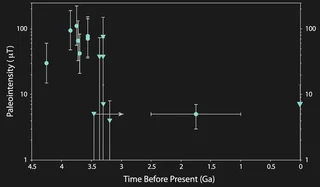
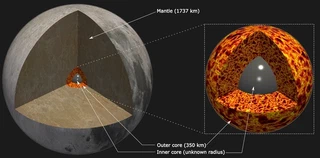
We found that a mix of convection and precession has the potential to explain the strength, decline, and eventual disappearance of the lunar field together.
External Fields (Mercury)
MESSENGER observations of Mercury’s magnetotail provided details of the planet’s field, but existing corrections for field-aligned currents (FACs) relied on empirical models.
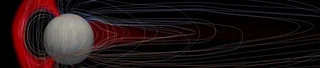
Along with Regupathi Angappan, I adapted the MHD code Kaiju (formerly GAMERA) to map the currents through Mercury’s magnetosphere and solve for the FACs directly, aiming to better correct the MESSENGER data.
Stellar angular momentum transport
Angular momentum transport from the core to the envelope of massive stars is a subject of active research. During the Kavli Summer Program in Astrophysics 2021, I supervised student Hachem Dhouib in studying this in a 3-solar-mass ZAMS star using the MagIC code. We found that internal gravity waves emanating from the radiative zone transport angular momentum through the star.
The video shows an equatorial section through the star with colors representing radial velocity: red (blue) is outward (inward).
Read the full project report here.
Uranus’s magnetic field from Voyager 2
Uranus has been visited by a spacecraft exactly once: Voyager 2’s 1986 flyby, which returned the only in-situ magnetic field measurements we have of the planet. I revisited that magnetometer data (from the Planetary Data System archives) to invert it for a spherical harmonic model of Uranus’s internal field, using a regularized least-squares inversion with an L-curve criterion to pick the optimal regularization strength.
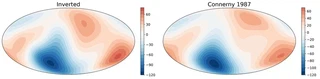
The recovered field agrees well with previously published models by Connerney et al. (1987), Holme & Bloxham (1996), and Herbert (2009). Code and figures are available at github.com/AnkitBarik/voyager2icegiants.