Scientific Software
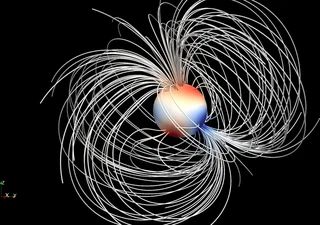
Simulating and analyzing planetary and stellar magnetohydrodynamics requires purpose-built tools. Here are the codes and packages I develop and maintain.
MagIC
MagIC is a numerical code that can simulate fluid dynamics in spherical geometry. It solves for the Navier-Stokes equation including Coriolis force, optionally coupled with an induction equation for Magneto-Hydro Dynamics (MHD), a temperature (or entropy) equation and an equation for chemical composition under both the anelastic and the Boussinesq approximations.
MagIC has been used in 174 publications (170 refereed) since 2002, according to NASA ADS.
MagIC is pseudo-spectral and makes use of spherical harmonics $Y_\ell^m(\theta,\phi)$ in the angular directions. In the radial direction, it offers two options: one can either make use of Chebyshev polynomials or finite differences.
I am one of the developers of MagIC, so feel free to reach out if you plan to use it for your work! For more information, visit: https://magic-sph.github.io/ .
Links: GitHub · Publication metrics (ADS)
Kore
Kore is a numerical code that can solve for wave-like solutions in rotating spheres and spherical shells. It solves for solutions to the combination of linearized Navier-Stokes, magnetic induction equation, a temperature (or entropy) equation and an equation for chemical composition under both the anelastic and the Boussinesq approximations.
Kore is fully spectral and makes use of spherical harmonics $Y_\ell^m(\theta,\phi)$ in the angular directions. In the radial direction, it expands every spherical harmonic coefficient in Chebyshev polynomials while using Gegenbauer polynomials to compute radial derivatives.
I am one of the developers of Kore, so feel free to reach out if you plan to use it for your work! Kore is free and open source.
Links: GitHub
Kaiju
Kaiju (formerly GAMERA) is written in modern Fortran and provides a flexible, portable, and exascale-capable MHD code. It uses the finite volume method to simulate magnetospheric dynamics.
I was involved in adapting it to Mercury in order to accurately compute the field-aligned currents (FACs) and better correct the MESSENGER data.
Links: GitHub
planetMagFields
planetMagFields is a package that provides an easy interface to plot and analyze planetary magnetic field data. It provides very easy access to the Gauss coefficients of a planet’s magnetic field obtained from inversion of planetary mission data, and an easy interface to plot, analyze and even produce files for 3D visualization of a planet’s magnetic field.
To learn more, check out the documentation here: https://ankitbarik.github.io/planetMagFields/
If you’re using this package for your work, please cite the paper in Journal of Open Source Software (JOSS):
Barik et al., (2024). planetMagFields: A Python package for analyzing and plotting planetary magnetic field data. Journal of Open Source Software, 9(97), 6677, https://doi.org/10.21105/joss.06677
Or bibtex:
 @article{Barik2024,
    doi = {10.21105/joss.06677},
    url = {https://doi.org/10.21105/joss.06677},
    year = {2024},
    publisher = {The Open Journal},
    volume = {9},
    number = {97},
    pages = {6677},
    author = {Barik, Ankit and Angappan, Regupathi},
    title = {planetMagFields: A Python package for analyzing and plotting planetary magnetic field data},
    journal = {Journal of Open Source Software}
 }
Links: Try the app · GitHub · Read paper
inermodz
A fluid rotating with solid body rotation (rotation rate $\Omega$ ) is stably stratified in angular momentum. It can be shown that a small perturbation to this fluid gives rise to a wave solution that oscillates with frequency $|\omega|\leq2\Omega$ . In the absence of boundaries (or far away from them), such a wave propagates as plane waves called “inertial waves”. In the presence of boundaries, the solution must satisfy boundary conditions (for example, impenetrability, $\boldsymbol{u}\cdot\hat{\boldsymbol{n}}=0$ ) and the solutions are global modes called “inertial modes”. These modes can be computed analytically for some container shapes such as a cylinder and a sphere. This Python package allows one to compute the analytical mode frequencies and solutions in a sphere.
Links: GitHub