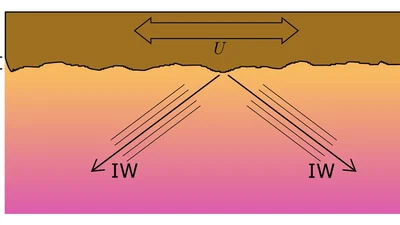
Nutation Damping From Core-Mantle Boundary Topography
Periodic gravitational forcing by the Moon and Sun produces small oscillations in Earth's rotation known as nutations. Nutations are amplified by a resonance with a natural motion …
jeremy-rekier
Periodic gravitational forcing by the Moon and Sun produces small oscillations in Earth's rotation known as nutations. Nutations are amplified by a resonance with a natural motion …
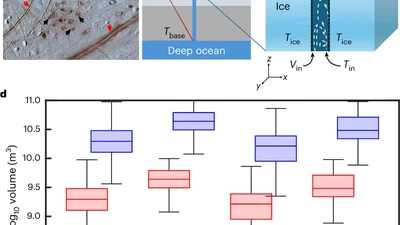
This study challenges the assumption that liquid water from Europa's deep subsurface ocean can readily rise through fractures in the ice shell to form shallow subsurface …
Thermal convection in rotating stars and planets drives anisotropic turbulence and differential rotation, both capable of feeding energy into global oscillations. Using 3D …
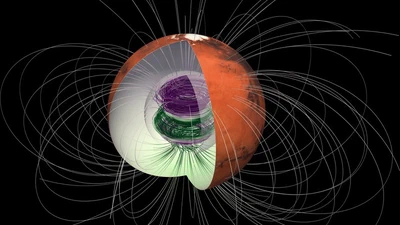
Seismic measurements from the NASA Mars InSight mission revealed that Mars' core has a relatively low density, implying a larger fraction of lighter elements than previously …
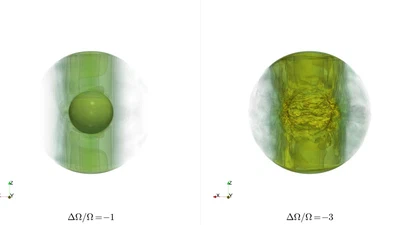
The spherical Couette system consists of two differentially rotating concentric spheres with the space in between filled with fluid. We study a regime where the outer sphere is …

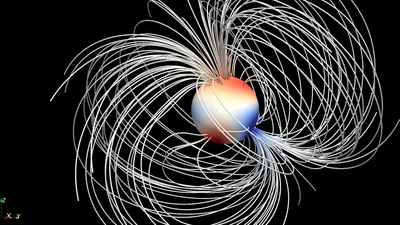
Long term observations and space missions have generated a wealth of data on the magnetic fields of the Earth and other solar system planets. `planetMagfields` is a Python package …
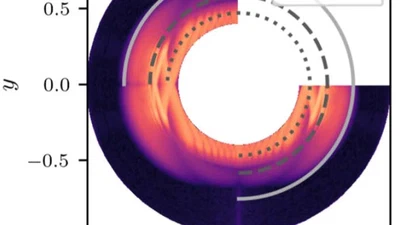
Observational constraints on Mercury's thermal evolution and magnetic field indicate that the top part of the fluid core is stably stratified. Here we compute how a stable layer …
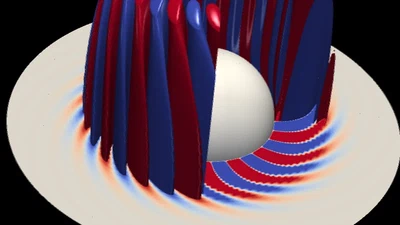
Convection in rotating spherical layers of fluid is ubiquitous in spherical astrophysical objects like planets and stars. A complete understanding of the magnetohydrodynamics …
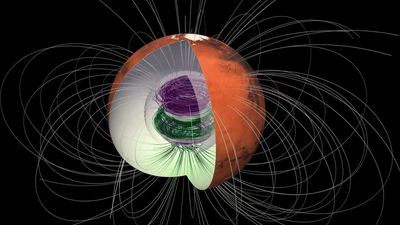
Magnetic field observations from the MGS, MAVEN, and InSight missions reveal that a dynamo was active in Mars's early history. One unique feature of Mars's magnetic crustal field …
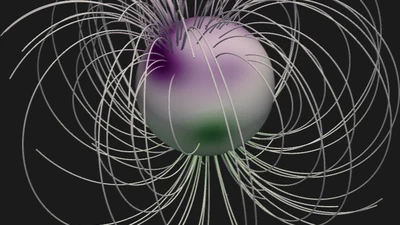
Understanding Jupiter's present-day interior structure and dynamics is key to constraining planetary accretion models. In particular, the extent of stable stratification (i.e., …