Nutation Damping From Core-Mantle Boundary Topography

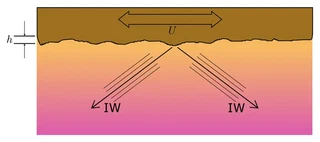 Fig. 1 from Rekier et al. (2026), JGR: Solid Earth: the quasi-diurnal tidal flow (U) in the core interacts with core-mantle boundary topography of height h, exciting internal waves (IW) that carry momentum away and dissipate energy.
Abstract
Periodic gravitational forcing by the Moon and Sun produces small oscillations in Earth’s rotation known as nutations. Nutations are amplified by a resonance with a natural motion of the liquid core called the Free Core Nutation, whose amplitude is limited by friction-like processes at the core–mantle boundary. Previous studies have attributed this damping to the dissipation of electric currents induced in the lower conducting mantle, but, given current knowledge of the lower mantle, electromagnetic coupling appears insufficient to fully account for the observed lag. We show that additional dissipation arises from the interaction of the tidal flow inside the core with the topography of the core–mantle boundary, which excites internal waves that extract energy and momentum from the flow. Adapting a theory originally developed for tides over seafloor topography, we find that the observed damping can be fully accounted for by a topography of typical amplitude ∼5 km dominated by features of wavelength ∼1,500 km. The dissipation is highest when the upper core is neutrally buoyant. Such amplitudes are larger than typical inferences from global seismic studies but are not ruled out, given regional seismic evidence for kilometer-scale features and the sparse constraints at these scales.
Type
Publication
Journal of Geophysical Research: Solid Earth

Authors
Planetary Scientist
I study the fluid dynamics and magnetic fields of planetary and stellar interiors using high-performance MHD simulations, and work as a research software engineer building physics-based simulation pipelines.